
Md. Azmat’s Powerlifting Approach & Deadlift Technique: Strength Built on Discipline
Md. Azmat begins by introducing himself in a way that instantly breaks stereotypes. Many believe that bodybuilders and athletes only lift weights and do nothing else — but Azmat represents a very different reality.
A business school graduate with 18 years of IT program management experience, he currently works for EXE, handling program management as his full-time profession. Alongside this demanding career, he is also a competitive powerlifter, proving that strength, discipline, and passion can coexist with a busy corporate life.
Powerlifting vs Bodybuilding: The Role of Rest
Azmat highlights one of the biggest differences between bodybuilding and powerlifting — the way rest periods are structured.
- Bodybuilders typically use shorter rest periods to maximise pump, metabolic stress, and calorie burn.
- Powerlifters require longer rest intervals to recover not just muscles, but the central nervous system (CNS).
To move massive weights efficiently and safely, the CNS must reset — and that doesn’t happen in 60 seconds. According to Azmat, a true heavy powerlifting set often requires 5–10 minutes of rest before the next one.
Deadlift Technique: Power, Position & Precision
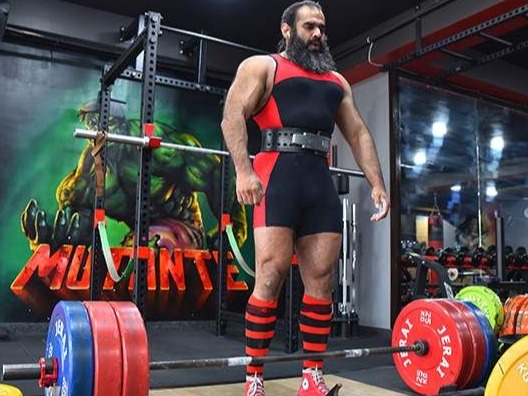
Azmat then prepares for his deadlift, showcasing a technique refined through years of practice and discipline. His goal is simple: move as much weight as possible with maximum efficiency and minimum risk.
1. The Setup
- Stand with your feet at shoulder width to generate optimal power from the legs.
- Hinge at the hips and lower yourself while keeping your back neutral.
- Grip the bar with your arms close to your shins, not too wide.
The optimal starting position includes:
- Shins perpendicular to the ground
- Shoulder blades over the bar for a strong pulling angle
- A vertical, efficient bar path for maximum force transfer
2. Bracing & Lifting
Before initiating the lift, Azmat takes a deep breath and braces his abdominal wall. This is crucial for:
- Protecting the spine
- Creating intra-abdominal pressure
- Generating more force off the floor
As he pulls:
- He engages his lats to keep the bar close and prevent it drifting forward.
- He focuses on pulling the bar in a straight line up the body.
- He thinks of squeezing the glutes and pushing the floor away, similar to a leg press.
At the top, he locks out by standing tall with a firm, tight lower back.
3. The Descent
The lowering phase is just as important as the lift:
- He allows the glutes and hips to guide the body back down.
- The bar is lowered with moderate speed — not dropped too fast, not lowered too slowly.
- This helps avoid unnecessary strain and reduces injury risk.
Azmat cautions beginners to start with light weights and only increase load when they are fully comfortable with proper form.
Romanian Deadlift: Building the Posterior Chain
To further strengthen the posterior chain, Azmat incorporates Romanian Deadlifts (RDLs) into his training. This movement is essential for:
- Developing the glutes
- Strengthening the hamstrings
- Improving spinal endurance
In his RDLs:
- He lowers the bar close to the ground without touching it.
- Maintains tension through the hamstrings and lower back throughout the movement.
- Comes back up in control, never rushing the rep.
Azmat describes RDLs as “bread and butter” for back hypertrophy, especially for those wanting thicker spinal erectors and a stronger middle back.
For this particular session, he completed 4 sets of 9 reps of deadlifts as part of his weekly training volume. The following week, he plans to change the weights while maintaining roughly the same volume.
What It Really Takes to Be a Powerlifter
Azmat closes by sharing what it truly means to be a powerlifter. It’s not just about chasing big numbers — it’s about:
- Discipline — showing up consistently, even on tough days
- Mutual respect — lifters appreciating each other’s effort and grind
- Relentless progression — getting stronger week after week
Powerlifting demands mental resilience and physical dedication. Day in and day out, lifters push through heavy sessions, recovery phases, and plateaus to keep progressing.
Azmat’s journey proves that you can balance a demanding career and serious lifting goals — as long as you have structure, patience, and passion.
Share this article with your friends and inspire someone to lift smarter, not just heavier.